
An exception is a problem that arises during the execution of a program. An exception can occur for many different reasons, including the following:
-
A user has entered invalid data.
-
A file that needs to be opened cannot be found.
-
A network connection has been lost in the middle of communications, or the JVM has run out of memory.
Some of these exceptions are caused by user error, others by programmer error, and others by physical resources that have failed in some manner.
Type of exceptions :
checked exceptions
unchecked exceptions.
This classification is based on compile-time checking of exceptions. There is also a classification based on runtime in java. It is not widely known! That is synchronous and asynchronous exceptions. First let us see the java checked exceptions and unchecked exceptions.
checked exceptions :
At compile time, the java compiler checks that a program contains handlers for checked exceptions. Java compiler analyzes by which checked exceptions can result from execution of a method or constructor.For each checked exception which is a possible result, the throws clause for the method or constructor must mention the class or its superclasses of that exception.
unchecked exceptions :
The class RuntimeException and its subclasses, and the class Error and its subclasses are unchecked exceptions classes. Because the compiler doesn’t forces them to be declared in the throws clause. All the other exception classes that are part of Throwable hierarchy are checked exceptions.
why exceptions are classified as checked exceptions and unchecked exceptions?
Those unchecked exception classes which are the error classes (Error and its subclasses) are exempted from compile-time checking in java because they can occur at many points in the program and recovery from them is difficult or impossible.
Example: OutOfMemoryError
Thrown when the Java Virtual Machine cannot allocate an object because it is out of memory, and no more memory could be made available by the garbage collector.
The runtime exception classes (RuntimeException and its subclasses) are exempted from compile-time checking because, in the judgment of the designers of the Java, having to declare such exceptions would not aid significantly in establishing the correctness of programs.
Example: NullPointerException
Thrown when an application attempts to use null in a case where an object is required.
So the java compiler doesn’t forces them to be declared in the above two cases.
Synchronous and Asynchronous Exceptions in Java
The interpreter executes the java program sequentially. An exception E can occur relative to a line (L) of program. That is that exception E will always occur at the execution of that line L. This is called Synchronous exception.
An asynchronous exception in java can occur at any point in the execution of a program.
They occur only as a result of:
- An invocation of the stop methods of class Thread or ThreadGroup
- An internal error in the Java virtual machine.
Exception Hierarchy:
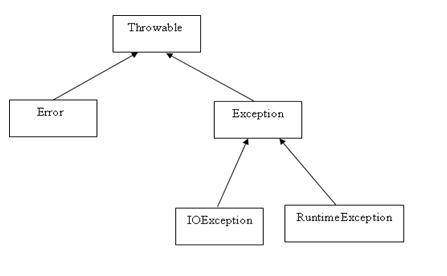
Exceptions Methods:
Following is the list of important medthods available in the Throwable class.
| SN | Methods with Description |
|---|---|
| 1 |
public String getMessage() Returns a detailed message about the exception that has occurred. This message is initialized in the Throwable constructor. |
| 2 |
public Throwable getCause() Returns the cause of the exception as represented by a Throwable object. |
| 3 |
public String toString() Returns the name of the class concatenated with the result of getMessage() |
| 4 |
public void printStackTrace() Prints the result of toString() along with the stack trace to System.err, the error output stream. |
| 5 |
public StackTraceElement [] getStackTrace() Returns an array containing each element on the stack trace. The element at index 0 represents the top of the call stack, and the last element in the array represents the method at the bottom of the call stack. |
| 6 |
public Throwable fillInStackTrace() Fills the stack trace of this Throwable object with the current stack trace, adding to any previous information in the stack trace. |
